
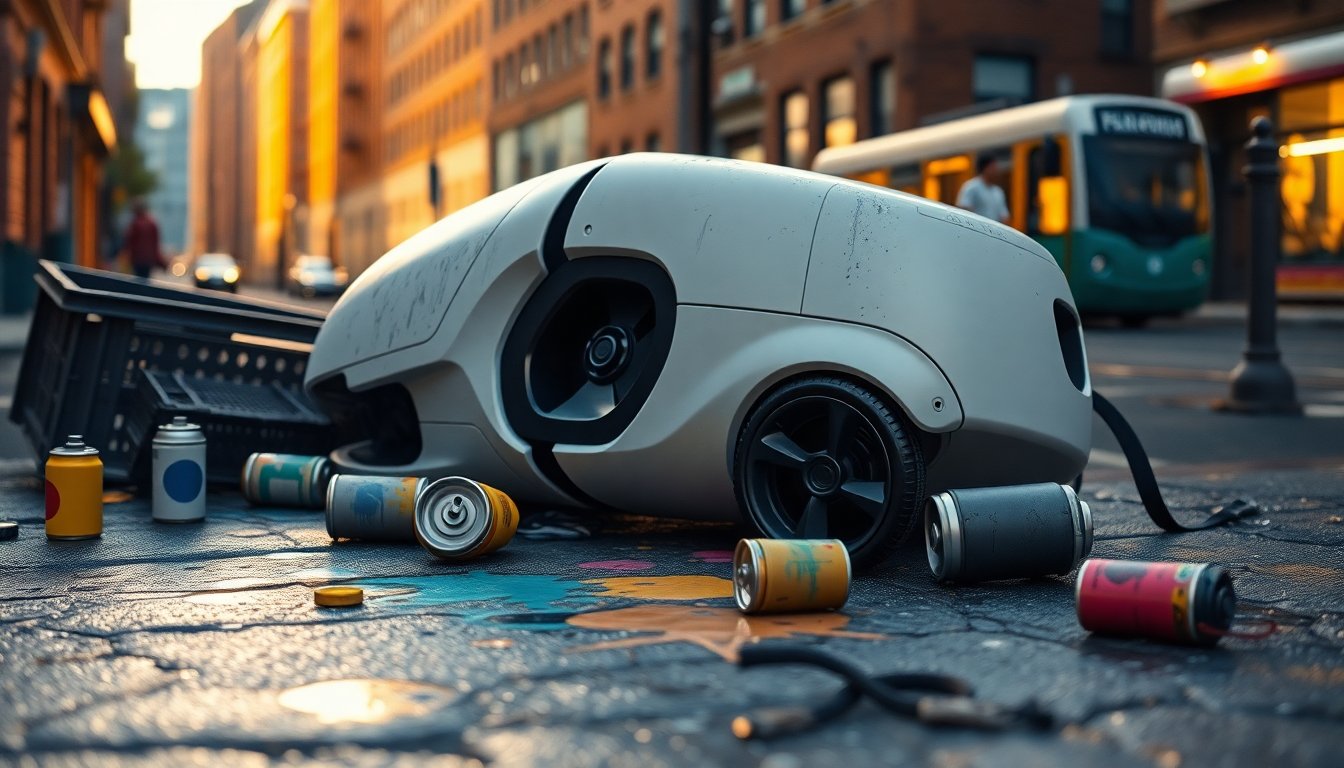
The city of Philadelphia introduced Uber Eats delivery robots on March 10, and within weeks those small autonomous couriers became the center of heated reactions from pedestrians. Videos circulating online showed people sitting on the machines, spray-painting them and, in one prominent incident in Center City in late March, kicking a unit so that it fell over. The rollout covers parts of the city including Center City, Chinatown and Old City, operating roughly between 10 a.m. and 10 p.m., and local business owners have mixed feelings about the new service.
Street-level clashes and the social media effect
Several of the confrontations with the delivery robots played out first on social platforms, where clips of people perching on or toppling the units quickly spread. Observers compared the episodes to earlier acts of vandalism against novelty machines in urban spaces—most famously the hitchhiking robot vandalized in 2015—and commentators suggested that online attention amplifies risky behavior. Temple University researchers note that many of these acts are not unique to Philadelphia: similar attacks and stunts have occurred in multiple U.S. cities, driven in part by the pursuit of viral content and the desire to engage with a conspicuous new object on the sidewalk.
Typical incidents and public reactions
Common episodes include sitting on top of the units, applying graffiti, and physically obstructing or striking the devices until they topple. In the Center City kicking incident, bystanders later helped set the robot upright. Local restaurateurs have a different angle: some see a chance to expand delivery capacity on busy nights when human drivers are scarce. One owner noted increased demand for deliveries during rain, suggesting that automated couriers could fill service gaps, even as some customers and passersby express annoyance or curiosity about the moving machines.
How the robots operate and how companies respond
The delivery units are provided by Massachusetts-based manufacturer Avride and deployed under the Uber Eats banner. Technically, the robots rely on LIDAR sensors and multiple cameras to map surroundings, move at roughly 5 miles per hour, and interpret traffic signals. The cargo compartment remains locked until the intended customer unlocks it through the Uber Eats app. Avride says its systems alert remote operators immediately if someone tampers with a robot and that operators can access the unit’s sensory feed and take control in an “extraordinary situation”. The company also maintains that the robots can function in rain and snow and that a conservative behavior model typically causes a robot to stop and wait when approached.
Company statements and service details
In public remarks, Avride framed early interference as part of a predictable curiosity phase when a novel technology appears in a neighborhood and stressed that a few vandalism cases will not derail expansion plans. The robots are active in multiple U.S. cities beyond Philadelphia, including Austin, Dallas and Jersey City, and the manufacturer highlights built-in safeguards such as remote monitoring and locked cargo bays. At the same time, the company urged people not to damage the units and emphasized that typical interactions tend to be short-lived, with passersby losing interest after a brief inspection.
Academic findings: why people harm robots and what to do about it
Researchers at Temple University’s Robot Social Navigation Amongst Pedestrians (roboSNAP) team have studied human reactions to autonomous machines and offer insights that go beyond simple curiosity. Lindsay Ouellette, who worked on a dissertation about abusing mobile robots, found that people’s motivations often skew toward what she calls instrumental violence—attacks motivated by an end goal like attention or reward—rather than strictly moral outrage at a malfunctioning machine. Her work also revealed that attempts to make robots more humanlike do not necessarily reduce aggression and can even enable dehumanization dynamics that normalize harm.
Donald Hantula, a faculty member involved in the research, argues that aggressive responses are a redirection of everyday frustrations—similar to irritation at a slow-moving pedestrian—and that cities should anticipate a baseline level of disruptive behavior toward any novel urban technology. From a design perspective, the scholars suggest prioritizing functional reliability and unobtrusive behavior over anthropomorphic styling: let delivery devices be clearly robots on wheels rather than miniature humanoids, and invest in public education and situational studies that explore cultural and cognitive responses to automation.
Balancing innovation and public acceptance
Philadelphia’s experience illustrates the tension between technological rollout and sidewalk etiquette: companies point to operational safeguards and broader rollout plans, while researchers and community members urge measured design and outreach. For businesses, the promise of extra delivery capacity is tangible; for residents, the machines are a conspicuous change to shared pedestrian space. Finding a path forward will likely involve a mix of engineering improvements, clearer rules for interaction, and ongoing study of how people perceive and sometimes punish autonomous devices in public.


