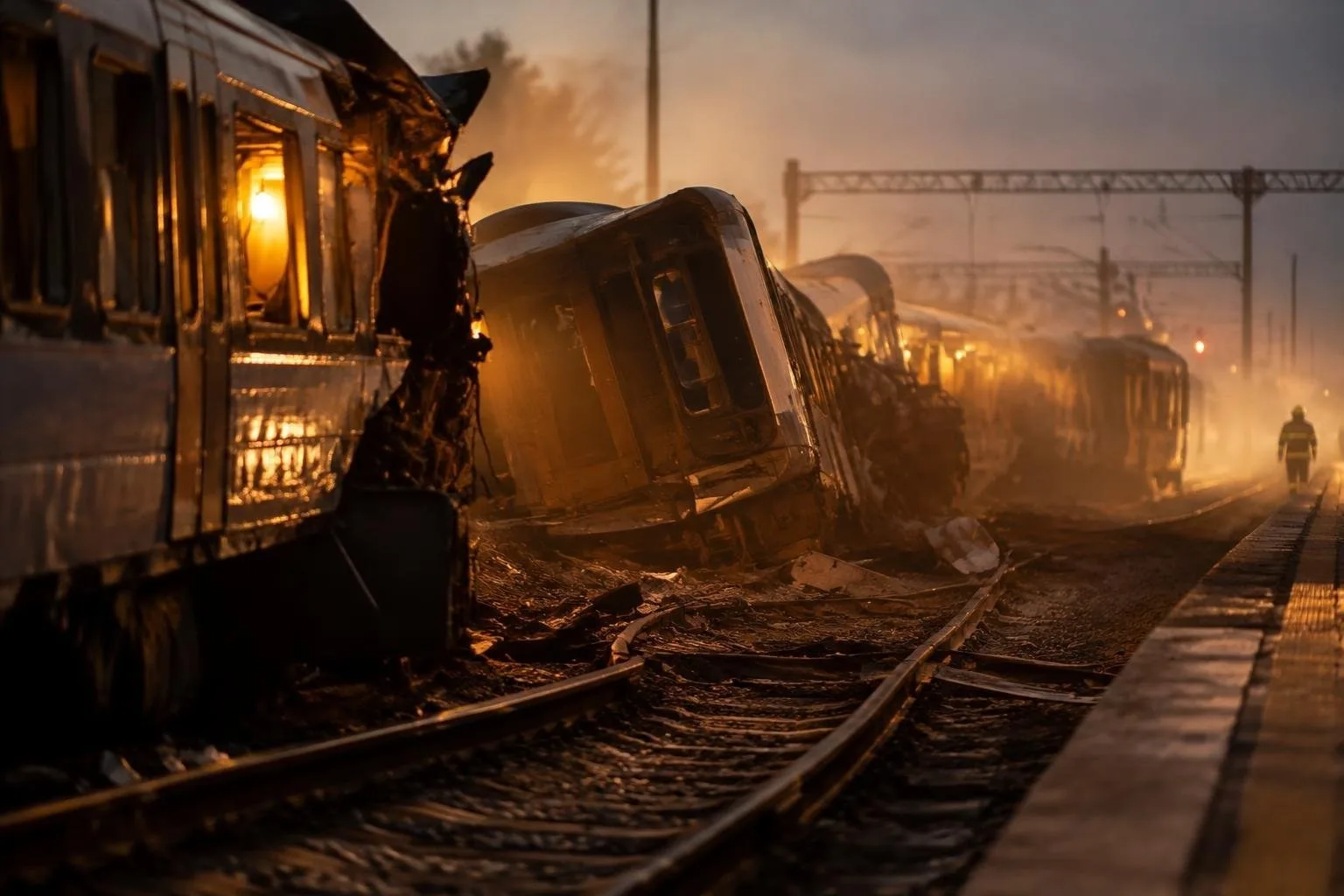
On Sunday, a catastrophic train collision occurred about 50 km south of Egypt’s capital, claiming seven lives and leaving more than a hundred passengers injured. The incident unfolded in the al-Ayat district of Giza province, where a train bound for Fayoum slammed into the rear of a stationary service heading toward Aswan. Emergency crews, local residents, and railway workers converged on the scene, battling dust, twisted metal, and the urgent need to rescue survivors.
The striking train was travelling from Giza to the southwestern city of Fayoum when it encountered the halted Cairo-Aswan service on the same track. The impact caused several carriages to derail, some of them crushing the interior of the stationary train. Witnesses reported that passengers were trapped inside mangled compartments, some succumbing before rescuers could reach them.
Details of the Sunday crash
According to the Ministry of Transport, the rear-end impact involved a passenger train bound for Fayoum colliding with the rear of the Cairo-Aswan train, which had been stopped on the line for an undetermined reason. The force of the collision derailed at least one set of coaches; officials have not clarified which train suffered the most severe damage. Initial counts from the Ministry of Health confirmed seven fatalities and 112 injuries, with more than 70 of the wounded released after receiving immediate treatment.
Victims and injuries
Rescue workers and villagers estimated that roughly 80 injured individuals were evacuated by ambulances to nearby medical facilities, including al-Wasta central hospital in Beni Suef province and three other hospitals that received the bulk of the casualties. Survivors described a chaotic atmosphere filled with choking dust and panicked passengers scrambling for exits. One survivor, Farha Gamal, recounted seeing several cars entirely twisted beyond recognition, while others were filled with passengers struggling to breathe.
Rescue operations and official reaction
Within minutes of the crash, the Egyptian Railway Authority dispatched emergency teams, cranes, and heavy-duty equipment to clear the wreckage and restore traffic on the disputed line. Local resident Ayman Gamal, who lives in Kafr Gerza, described how neighbours rushed to the site, pulled survivors from the wreckage, and called for ambulances. Around 72 ambulances were eventually mobilised to transport the injured to medical centres. President Abdel Fattah al-Sisi posted on social media, ordering an immediate and thorough investigation and demanding accountability for those responsible.
Doctors at the three receiving hospitals reported that many of the injured suffered from traumatic fractures, lacerations, and respiratory distress caused by the dense dust cloud that rose when the cars derailed. Some patients remained in critical condition, while others were discharged after stabilisation. The rapid deployment of medical resources was praised by eyewitnesses, who noted the coordinated effort between railway staff and local volunteers.
Railway safety record and reforms in Egypt
Egypt’s railway network, serving over 110 million citizens, has a long history of accidents attributed to ageing infrastructure and insufficient maintenance. The 2002 disaster, which killed more than 300 people in a fire aboard an overnight train, remains the deadliest in the nation’s history. In recent years, the government announced modernization plans, allocating billions of dollars toward new high-speed lines and upgraded signalling systems. Nevertheless, incidents such as the September freight-train collision in the same district demonstrate that systemic challenges persist.
Analysts point out that the al-Ayat district has become a hotspot for railway mishaps, with this latest tragedy adding to a growing list of high-profile accidents. While the Ministry of Transport emphasizes ongoing reforms, critics argue that the pace of upgrades is insufficient to match the heavy reliance on rail transport for daily commuting and long-distance travel. The forthcoming investigation, ordered by President al-Sisi, is expected to examine procedural lapses, signalling failures, and human error that may have contributed to the crash.
As the wreckage is cleared and services gradually resume, families of the victims mourn their losses while the broader public awaits answers. The incident underscores the urgent need for a comprehensive safety overhaul, ensuring that Egypt’s railways can safely accommodate the millions who depend on them each day.