
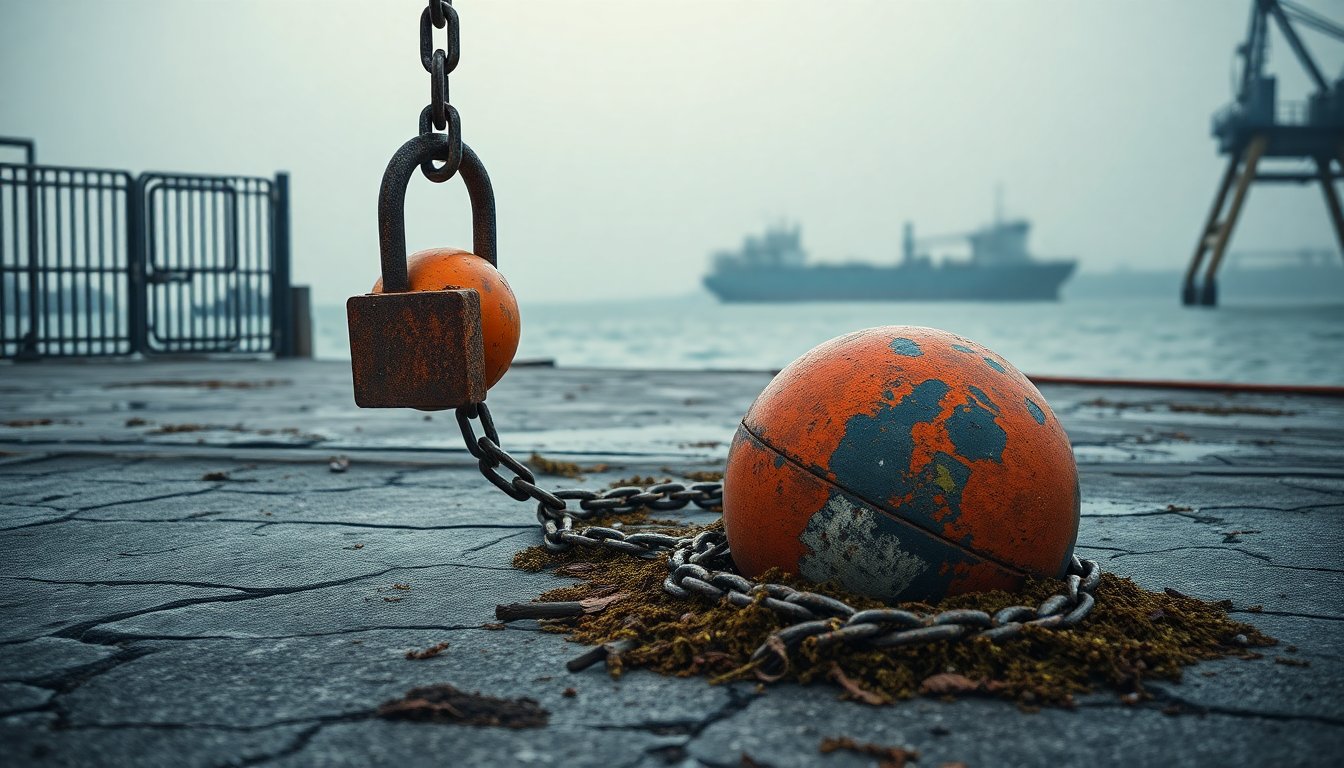
The strategic Strait of Hormuz has become a flashpoint again as Tehran says it will keep the waterway closed until Washington lifts a blockade on Iranian ports. The move follows high-level but inconclusive talks and reports that the waterway was mined, leaving shipping at risk. Observers warn that a combination of maritime hazards and firm political positions makes reopening the strait a complicated prospect.
The diplomatic picture remains fragile: negotiators have reported some progress in conversations held in Pakistan, yet key gaps persist. A two-week ceasefire is in place but will end on Wednesday unless parties agree to extend it. Meanwhile, military statements from both sides and legal questions around sea control are fueling uncertainty for international trade and regional security.
How mines and maritime control closed a vital corridor
Reliable reporting indicates that Iran deployed naval mines in the Strait of Hormuz, and that many of those devices were not tracked or catalogued. The result is an effective shutdown: even the possibility of drifting mines is enough to halt normal traffic. Navigational warnings and an Iranian requirement that vessels coordinate with its forces have left commercial shippers rerouting, delaying or suspending journeys through this crucial chokepoint.
Why mines matter
Naval mines create a persistent hazard because, unlike a visible threat, their locations can shift and remain unknown. That technical reality has practical consequences: insurers raise premiums, operators divert routes, and states face hard choices about clearance operations. The uncertainty has turned the strait from an international shipping lane into a militarised zone, where the presence of unexploded ordnance keeps normal transit passage from functioning.
Blockade, legal implications and military enforcement
The United States announced a targeted maritime action that, after clarification, seeks to block maritime traffic entering and exiting Iranian ports. CENTCOM specified that the measure applies to vessels destined for or departing Iranian coastal areas and said it would not impede ships merely transiting the strait to non-Iranian ports. That restriction, announced to take effect on April 13, has nevertheless been interpreted in Tehran as an escalation that undermines the ceasefire dynamics.
Legal scholars point to sharply different interpretations of maritime law. A blockade is conventionally a wartime act that can alter ceasefire conditions, while obligations enshrined in older treaties require belligerent states laying mines to take precautions to protect neutral shipping. Questions about compliance and the legality of unilateral interdictions will shape whether allies join enforcement efforts and how long restrictions remain in place.
Diplomacy, domestic politics and regional reverberations
On the diplomatic front, Iranian parliamentary speaker Mohammad Bagher Ghalibaf acknowledged some movement in conversations with Washington but said fundamental differences remain and that a final deal is still distant. Pakistan hosted marathon sessions that yielded partial understandings but no comprehensive agreement, and regional leaders such as Pakistan’s Prime Minister Shehbaz Sharif, who recently travelled to Saudi Arabia, Qatar and Turkiye, have continued shuttle diplomacy to keep talks alive.
Iranian officials have spoken publicly to reassure domestic audiences. President Masoud Pezeshkian rejected arguments that Tehran should lose its nuclear rights, while Supreme Leader Mojtaba Khamenei lauded the navy. At the same time, Deputy Foreign Minister Saeed Khatibzadeh cautioned about future negotiations and voiced frustration with the unpredictability of the process.
Regional fallout
Military pressure and incidents have spread across the region. US forces say they forced 23 ships to turn back near the strait as they began enforcing port restrictions, while Iranian commanders warned that any vessel attempting to transit without permission risks being considered a hostile collaborator and targeted by the IRGC. Israel, Lebanon and UN observers have also reported combat casualties and violations tied to the wider conflict, underscoring how local battles feed broader instability.
Civilian life and infrastructure are affected: authorities in Tehran have delayed a return to in-person schooling, and Iran plans to reopen airspace gradually. In Israel, officials reported combat losses and neighbourhood damage, while the UN condemned attacks that killed peacekeepers. Statements from groups such as Lebanon’s Hezbollah, and from officials who question external draft ceasefire texts, illustrate how fragile any agreement remains on the ground.
What happens next
The path ahead depends on several linked variables: whether mines are located and cleared, whether the United States and its partners sustain or expand maritime restrictions, and whether negotiators convert partial understandings into a robust deal. The imminent expiry of the two-week ceasefire on Wednesday — unless extended — is a near-term milestone that could either pressure parties into compromise or trigger renewed hostilities.
For now, the situation is one of managed risk: the Strait of Hormuz stays closed to routine commerce, legal disputes over the nature of blockades and mine-laying complicate multilateral responses, and political leaders on both sides signal readiness to continue pressure. Any resolution will require technical maritime work, political concessions and coordinated international engagement to restore safe, lawful passage through this vital artery.


