
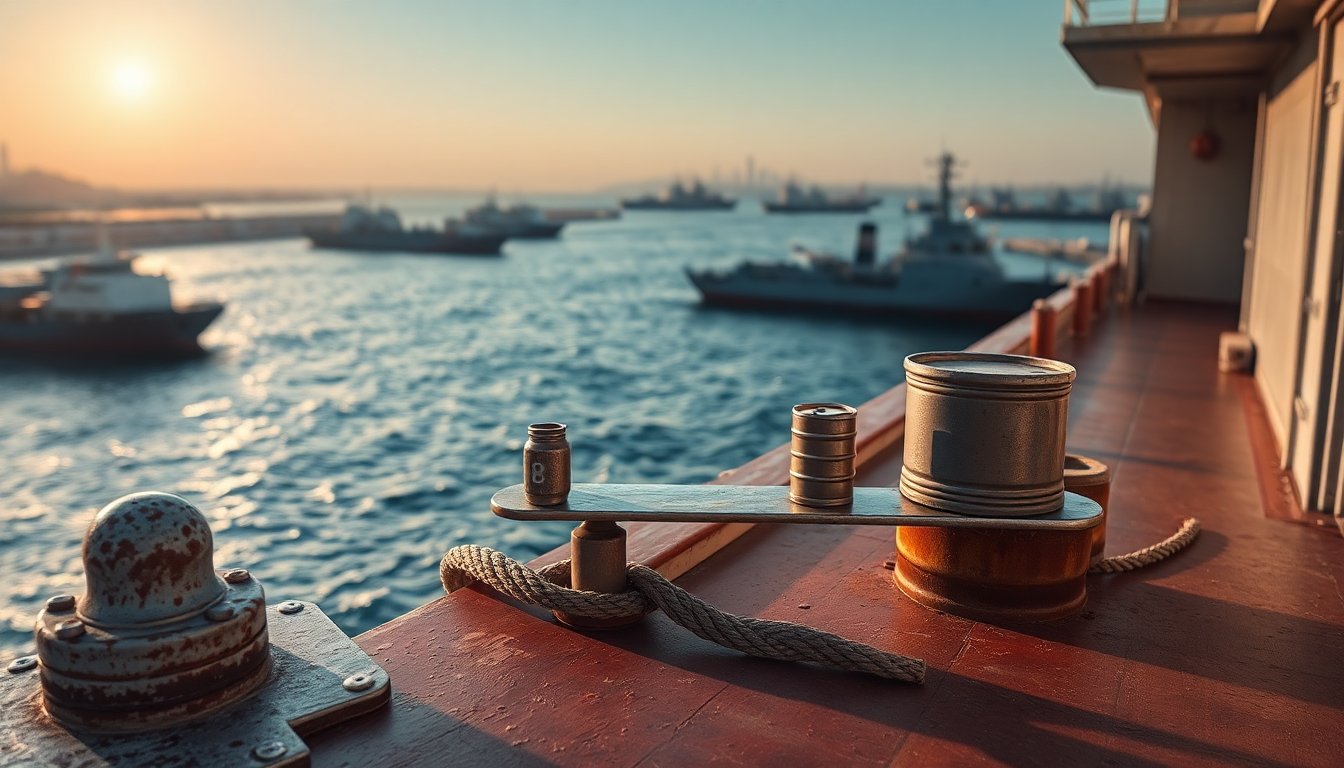
The United States announced a maritime operation reported on 14/04/2026 that has already intercepted and turned back six ships departing the Strait of Hormuz. Officials described more than a dozen American warships positioned in the Gulf of Oman and the Arabian Sea as forming a kind of net to restrict access to Iranian ports. The encounters so far “have not required escalation,” according to military sources, but the action marks a significant intensification of pressure aimed at forcing Iran to reopen the vital waterway and resume normal commercial transit.
President Donald Trump publicly framed the move as a response to Iran’s prior restrictions on tanker movements and said the blockade had begun. In forceful social media comments he warned that Iranian fast-attack craft approaching the cordon would be “immediately eliminated“—a phrase that sharpens the stakes for any maritime contact. At the same time, CENTCOM issued statements clarifying that vessels traveling between non-Iranian ports may transit the strait, undercutting earlier broader threats and illustrating the delicate balance between deterrence and freedom of navigation.
How the blockade is being implemented and its operational limits
Enforcement of a maritime blockade is resource-intensive and legally complex. U.S. officials said roughly 16 warships are in the broader Middle East theatre, while one anonymous official noted that none of those vessels were in the Persian Gulf proper at the time of the announcement; another frame described the deployed ships as concentrated in the Gulf of Oman and Arabian Sea. A published notice to mariners warned that access to Iranian ports would be restricted, but also acknowledged that the precise rules and procedures “are in development.” That ambiguity matters: convincing merchant captains to comply depends on clear, credible protocols and sustained naval presence.
Practical hurdles at sea
The Strait of Hormuz is narrow and busy—roughly one-fifth of the world’s traded oil passes through it in peacetime—so the sheer volume of traffic is a major enforcement hurdle. Analysts say a blockade that aims to stop or divert significant numbers of tankers and cargo ships will require continuous patrols, boarding teams and logistical support for crews and ships. Skeptics point out the difficulty of maintaining an effective cordon without international partners, while supporters argue that concentrated naval assets can interdict targeted transits to create leverage.
Legal questions and humanitarian exemptions
Lawyers and retired naval judges emphasize that how a blockade is run will determine its legality. International rules require impartiality and the issuance of clear warnings to mariners; they also contemplate specific allowances for relief supplies. The U.S. administration will need guidance from the Navy’s legal office and to consider an explicit humanitarian exception for food, medicine and other relief cargo. Failure to allow neutral relief shipments could expose the operation to accusations of unlawful coercion.
Diplomatic implications
Impartial enforcement is not just a legal nicety; it affects cooperation with allies and the willingness of third-party flag states to accept interceptions. A blockade that is seen as arbitrary risks broader diplomatic backlash and could push trading partners toward tolerated workarounds—such as covert transits or alternate routes—that blunt its effect. At the same time, public statements from world leaders are already pressing for coordinated action to avoid a wider escalation and to restore freedom of navigation in the strait.
Economic fallout and supply chain exposure
Markets reacted immediately. Brent crude spiked—briefly rising about 7% and hovering near US$102 a barrel in some trading sessions—while global crude has generally traded well above US$100 since the crisis began, up from roughly US$70 a barrel before the larger conflict erupted. Those spikes translate into higher costs at the pump, increased shipping insurance and broad inflationary pressure for households and businesses worldwide.
Beyond oil, the strait is a conduit for chemicals, metals and agricultural inputs. Supply chain experts warn that roughly 30% of the world’s fertiliser transits this region; interruptions could ripple into higher food prices and threaten seasonal harvests. Import-dependent Gulf states could face acute price and supply stress, while manufacturers elsewhere would feel the knock-on effects of delayed raw materials and higher transport costs.
Escalation risks and likely Iranian responses
Analysts caution that a blockade may prompt asymmetric Iranian countermeasures. Possible responses include the deployment of naval mines, the use of small fast-attack boats, and missile strikes against maritime targets—tactics that could provoke broader disruption and risk direct clashes. Tehran’s public warnings that “no port in the region will be safe” underscore the danger that the standoff becomes more than a supply chain problem and instead spirals into renewed kinetic confrontation.
The operation announced on 14/04/2026 therefore sits at a fraught intersection of strategy, law and economics. Its immediate effect—turning back six vessels and deploying a flotilla to act as a maritime net—is clear. How long the effort will be sustained, whether it can be administered within international legal norms, and what economic toll it will take remain uncertain. For now, governments, shippers and markets are watching closely for signs that the blockade will ease or intensify.


