
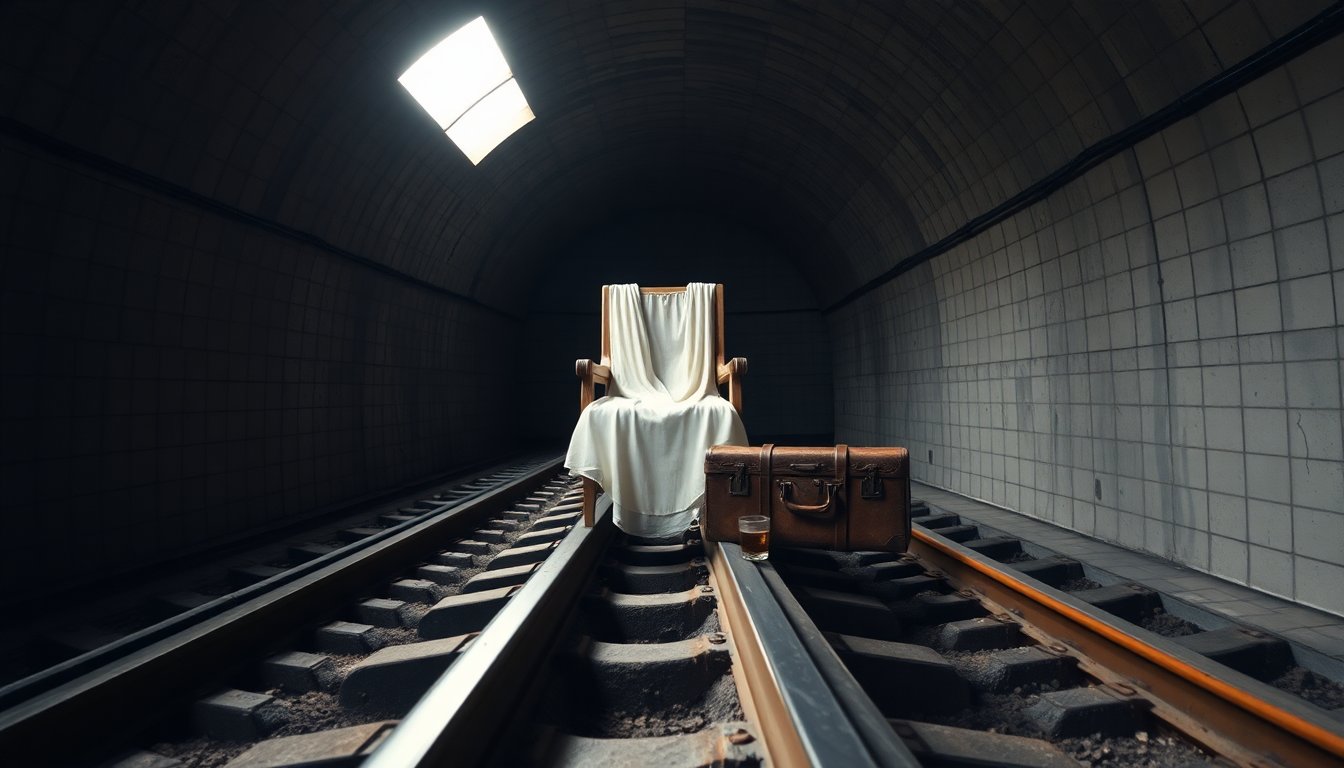
The Streetcar Project brings a radically pared-down version of A Streetcar Named Desire to Dupont Underground from April 20-May 4. This production, co-created by Lucy Owen (who plays Blanche DuBois) and director Nick Westrate, trades period trappings for a focus on speech and presence. Rather than recreating a cramped New Orleans apartment, the company stages the piece in a reclaimed transit space at 19 Dupont Circle, N.W., performing literally on the old tracks. The result is an encounter that prioritizes language-led performance and theatrical immediacy over conventional scenic illusion.
From its origins, the project has been about adaptability: an idea conceived to travel through unusual venues and to be stripped to essentials. The ensemble’s approach removes many familiar markers—costume flourishes, elaborate props, and even Blanche’s cultivated southern accent in some scenes—so that text and actorly choices become the engine of the drama. This methodology is informed by an interest in site-specific theater and in testing whether Williams’s dialogue can carry the play without the usual visual cues; the company believes the play’s language is robust enough to do so.
How the production reframes a classic
The company intentionally pursues a minimal staging philosophy, asking audiences to supply atmosphere through imagination. In this iteration, elements that often signify Blanche’s past—her trunk of clothes or a cluttered hotel room—are either implied or absent, so that the conflict between Blanche and Stanley rests on tonal shifts and textual rhythm. The creative choice foregrounds textual primacy: when scenery and period markers are reduced, the words, silences, and gestures must map the characters’ interior landscapes. For many viewers this results in a sharper sense of psychological intensity and an invitation to engage actively with what the production asks them to imagine.
Why Dupont Underground matters
Choosing Dupont Underground—a repurposed 1949 streetcar station—is more than an aesthetic flourish: the site amplifies the show’s formal conceit. The long, curved tunnel and the presence of tracks give the piece a literal and metaphorical axis; the performers move through a space that already carries traces of transit and memory. The company notes that each venue they select contributes dramatically to the work: a Soho shop suggested one set of associations, a Venice Beach workshop offered harsher industrial imagery, and here the former station supplies an eerie, resonant frame. The site becomes a collaborator in the storytelling.
Cast, creative team, and performance choices
The production keeps a small core company, led by Lucy Owen as Blanche and directed by New York-based Nick Westrate, whose background as an actor (including notable regional credits) informs his directorial eye. Because the show travels with a consistent ensemble, actors develop deep ownership of the material and of the particular staging choices the company makes. That continuity lets the cast accept logistical trade-offs—performing without conventional dressing rooms and moving across nontraditional surfaces—while preserving a strong collaborative tie to the piece. The company has also presented the work in houses such as Aspen’s Wheeler Opera House and San Francisco’s A.C.T., adapting the same minimal vocabulary to each setting.
Artistic intentions and audience response
Practically speaking, the production asks audiences to abandon certain preconceptions about how a canonical play should look. Initial reactions commonly include surprise or uncertainty, but many spectators report that within minutes they begin to mentally supply the omitted details and to follow the characters more closely. The company frames this as a civic experiment in theatrical imagination: by stripping away ornament, they test whether the drama can survive and even be heightened by constraint. Tickets start at $85, and the run at Dupont Underground is one stop on a traveling experiment in making classic texts portable and immediate.
What to expect and how to prepare
Visitors should anticipate a performance that privileges voice, pace, and proximity over spectacle. Found spaces and unconventional sightlines mean that seating and movement patterns may differ from a traditional theater; the production’s website and venue announcements provide details on access and logistics. For those curious about theatrical form, this staging offers a direct lesson in how site-specific choices and scarcity of design can sharpen focus on character and language. Whether experienced as a reinvention or a radical reduction, this version of A Streetcar Named Desire is designed to make the familiar feel newly precarious and immediate.


