
Table of Contents
In a notable development, President Donald Trump has issued a warning concerning the Gordie Howe International Bridge, an infrastructure project designed to connect Michigan with Canada. His declaration on social media has ignited discussions about trade relations and the intricacies of international agreements.
On Truth Social, Trump accused Canada of exploiting the United States through what he labeled unfair trade practices. He expressed concerns regarding Canada’s growing ties with China, framing this diplomatic shift as harmful to American interests.
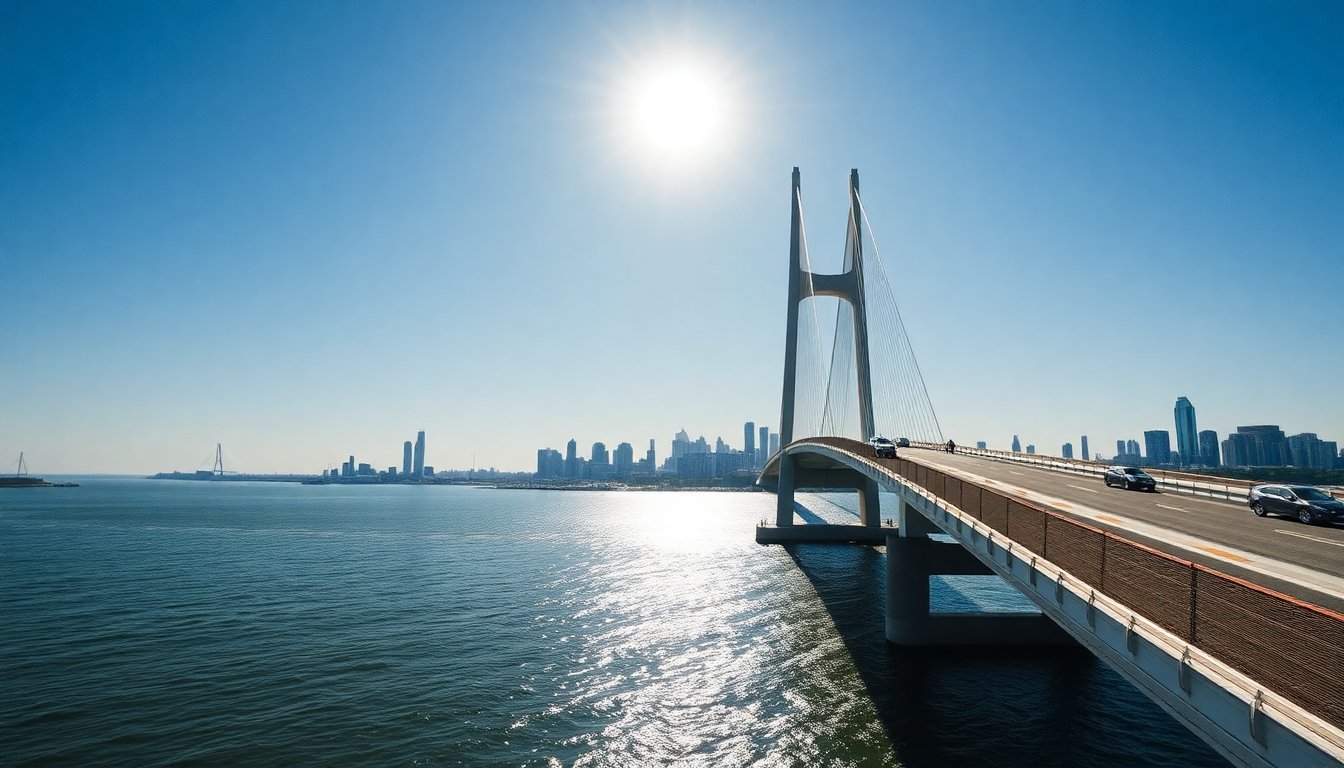
The Gordie Howe International Bridge: A symbol of cooperation
The Gordie Howe International Bridge, named after the legendary Canadian hockey player, aims to strengthen economic ties between Detroit and Windsor, Ontario. Despite its potential benefits, Trump asserted that he would not allow the bridge to open unless the U.S. receives adequate compensation for its contributions and is treated with fairness and respect.
Currently, the bridge’s construction is entirely funded by Canada, while Michigan retains partial ownership. Trump’s remarks have initiated a debate about ownership and financial responsibilities related to this major infrastructure project. He argued, “We should own, perhaps, at least one half of this asset,” reflecting his belief that the U.S. deserves a larger stake.
Trade dynamics at play
Trump’s statements highlight a broader narrative where he has accused Canada of disproportionately benefiting from U.S. trade policies. He specifically pointed to the exclusion of American alcoholic beverages from Canadian markets, emphasizing perceived inequities. “Ontario won’t even put U.S. spirits, beverages, and other alcoholic products on their shelves,” Trump remarked, underscoring a lack of reciprocity in trade.
This rhetoric aligns with Trump’s ongoing trade conflict with Canada, which has become Michigan’s largest trading partner. Following last year’s tariffs on Canadian products, Canada has sought to diversify its trade relationships, including agreements with China. This shift has heightened tensions, with Trump’s comments serving as a direct reaction to Canada’s diplomatic efforts.
Implications for Michigan’s economy
The potential postponement of the bridge’s opening could have significant consequences for Michigan’s economy. Local leaders, including Senator Elissa Slotkin, have expressed their concerns, arguing that the president’s threats unfairly penalize Michiganders for actions stemming from his trade war. “This threat would be awful for our state’s economy,” Slotkin stated, emphasizing the bridge’s critical role in trade and transportation.
Governor Gretchen Whitmer also commented, stating that the bridge represents bipartisan cooperation and is essential for the state’s automotive sector. “This project has been a tremendous example of bipartisan and international cooperation,” Whitmer asserted, assuring citizens that the bridge will eventually open, independent of the political climate.
A call for negotiation
Trump’s ultimatum to Canada includes a demand for immediate negotiations, asserting that the U.S. should be compensated for its contributions. His firm stance signifies a desire to recalibrate trade terms, urging Canada to reevaluate its policies regarding American products. The negotiation dynamics remain uncertain, as the president’s threats could complicate an already fragile economic relationship.
As discussions progress, the Gordie Howe International Bridge stands not only as a physical link between two nations but also as a symbol of the complex web of trade agreements that connect the U.S. and Canada. The outcome of this situation will inevitably shape future interactions and the economic landscape for both countries.