
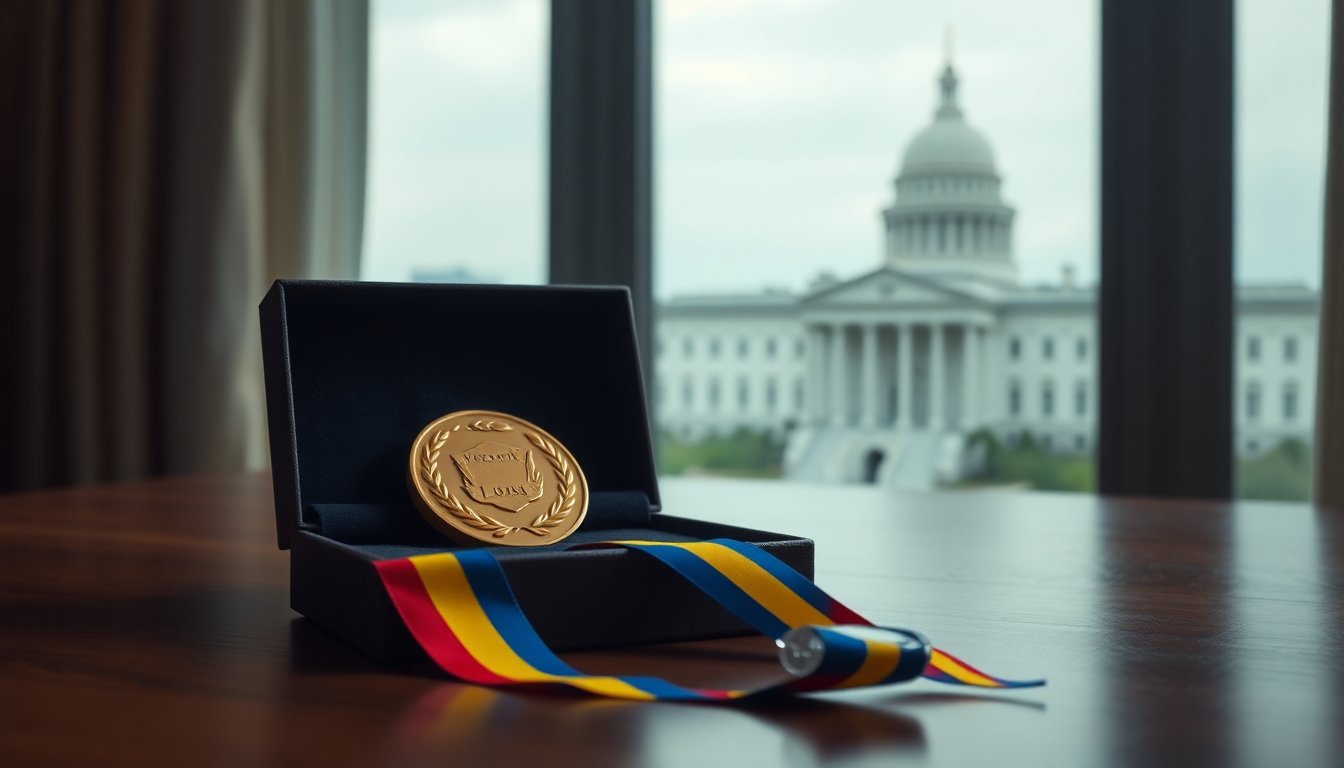
The political spectacle surrounding Venezuela’s opposition leader Maria Corina Machado has intensified after she publicly handed her Nobel Peace Prize medal to Donald Trump. Machado, who was named the 2026 recipient of the award, travelled to Oslo to collect the prize after a period in hiding, and then met the US president in Washington in January to present the physical medal. She has since said she feels no regrets about the gesture, framing it as recognition of what she described as decisive US action against the government of Nicolas Maduro. The transfer has raised complicated legal and symbolic questions because the awarding body is explicit about the prize’s status.
What happened at the White House and why it matters
At the heart of the controversy is a dramatic sequence of events: US forces carried out an operation that led to the removal of Nicolas Maduro from power and his subsequent detention in the United States on drug trafficking charges. Machado says she presented her medal two weeks after that operation, calling the action something Venezuelans will not forget. The meeting at the white house included photo opportunities and a framed display of the medal, which Mr. Trump described as a “wonderful gesture of mutual respect.” For Machado, the moment was meant to highlight a partnership with the United States in pursuit of a democratic transition for Venezuela, and she has indicated coordination with Washington about her return to the country.
Legal and symbolic limits
Despite the public ceremony, the Norwegian Nobel Committee has reiterated that its awards are nontransferable, meaning the prize cannot legally or procedurally be passed on to another person. The committee also emphasized that the medal and prize are intended to recognize individual efforts—in Machado’s case, her campaign to restore democratic rights in Venezuela and to pursue a peaceful shift away from authoritarian rule. Observers note the difference between public symbolism and formal ownership: handing over a medal as a sign of gratitude does not change the committee’s official record, and the committee has no mechanism to rescind or reassign the laureate status.
Reactions in Washington and regional politics
The reception in the US capital has been mixed. While the White House framed the meeting as supportive of Venezuelan aspirations for free elections, President Trump himself has publicly questioned Machado’s domestic support, labeling her a “very nice woman” but suggesting she does not command broad respect inside Venezuela. Meanwhile, the White House has signalled openness to other Venezuelan figures, including former Maduro vice president Delcy Rodriguez, provided they align with US interests—especially regarding access to Venezuela’s oil resources. This tug-of-war underscores the pragmatic calculations shaping Washington’s posture toward Venezuelan opposition factions and interim authorities.
Machado’s return plans and political standing
Machado, who left Venezuela in December to accept her Nobel Prize in Oslo after living covertly for months, has said she is coordinating with the US government about re-entering the country. She has cast the United States as a key actor in advancing the democratic transition she seeks, while opponents and some analysts argue that close ties to foreign power can complicate a leader’s credibility at home. Machado’s ban from the disputed 2026 presidential ballot and her unresolved decision about standing in any future election further complicate her domestic political calculus.
Diplomatic fallout and what it means for Venezuela
The incident has broader diplomatic repercussions: Machado declined a meeting with Spain’s Prime Minister Pedro Sanchez while visiting Europe, citing his hosting of a progressive leaders’ summit as a reason the meeting would be inadvisable. That refusal contrasted with her readiness to meet conservative counterparts in Spain and elsewhere. The episode exposes fissures among international supporters of Venezuela’s opposition and highlights how symbolic acts—such as gifting a Nobel medal—can ripple through alliances, complicate negotiations over oil and prisoners, and reshape narratives about legitimacy. For Venezuelans watching from inside and outside the country, the medal handover is both a personal statement by Machado and a signal of shifting geopolitical alignments.


