
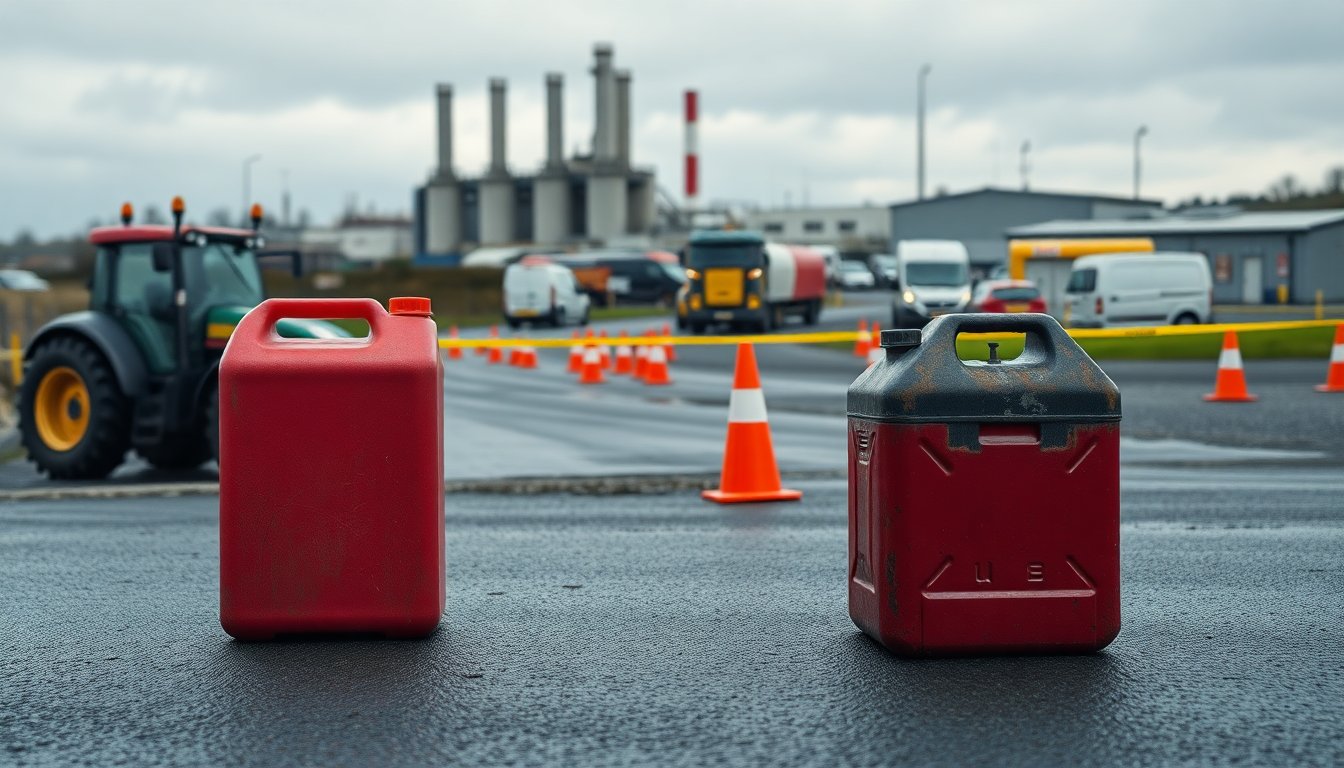
On April 11, 2026, Ireland saw a major security operation at the Whitegate refinery in County Cork after days of demonstrations that impeded the flow of petrol and diesel to the rest of the country. The standoff began when convoys of tractors, lorries and vans—led by farmers and hauliers—parked to block tanker access to key fuel depots. Authorities said the disruption jeopardized supplies for emergency services and provoked a wave of panic-buying that left many filling stations struggling to serve customers.
The government response combined policing resources with military support after the Justice Minister authorised assistance to the Garda. Officers in protective gear used pepper spray to clear some barricades while Defence Forces engineers employed heavy-lift vehicles to remove disabled tractors and trucks. Organisers on social media vowed wider actions, and industry groups warned of rapidly diminishing stocks across forecourts nationwide.
The Whitegate operation and what happened on site
At Whitegate, police pushed through physical blockades to allow escorted tankers to access the plant, with footage showing protesters temporarily held back behind newly erected steel barriers. The deployment of army engineers focused on removing road obstructions and enabling critical deliveries; several vehicle owners surrendered ignition keys rather than resist removal. Officials framed the move as necessary to restore distribution to fuel depots that supply both private forecourts and essential public services, highlighting the national security implications of sustained closures.
Protesters said their action targeted the high retail cost of motor fuel, demanding deeper reductions in taxes that currently make up a significant slice of pump prices. The government had already introduced a temporary tax cut the previous month in response to global price shocks, but the demonstrators said the measure was insufficient. While law enforcement reported no major injuries during the clearance, scenes of tense confrontations and the use of chemical irritants underscored how volatile the situation had become.
Supply risks and the growing impact on distribution
Industry groups painted a stark picture of depletion at service stations: trade bodies estimated that roughly 600 of Ireland’s 1,500 forecourts had run dry amid the blockades, and warnings circulated that two-thirds of outlets could be affected if depots remained inaccessible. Tanker movements were impeded not only at Whitegate but also at fuel storage hubs in Galway and Foynes, and a foreign vessel reportedly remained idling offshore because local tanks were full and traffic in port had stalled. The combined effect raised immediate concerns about fuel availability for commuting, freight and emergency responders.
Ports and freight under pressure
The protests extended disruption to maritime logistics: Rosslare and other post-Brexit freight routes experienced long truck queues and the prospect that inbound ships might be turned away if offloading could not proceed. Rail and bus operators adjusted services as road blockages affected timetables, while the National Emergency Coordination Group flagged that fuel for ambulances and fire services was coming under “increasing pressure.” These operational strains illustrated how a concentrated blockade at a few choke points can ripple through a national supply chain.
Politics, negotiations and the movement behind the blockades
Government ministers declined to engage directly with the spontaneous demonstrators on the grounds that they were acting outside recognised representative bodies such as the Irish Farmers’ Association and the Irish Road Haulage Association. Officials held talks with industry leaders to finalise a new package of supports aimed at haulage, agriculture and contracting sectors, while urging protesters to stand down. Meanwhile, grassroots organisers using online channels called for further demonstrations across all counties, signalling a potential escalation if formal concessions were not delivered.
What comes next
With supply lines partially restored at Whitegate but other depots still blocked, authorities and industry representatives were warning of a precarious window in which fuel shortages could deepen. The government pressed for an end to the blockades so that distribution could normalise, while protesters insisted that only binding commitments on fuel taxation and direct engagement would end their actions. In the near term, the interplay between law enforcement operations, military logistics support and political negotiation will determine how quickly Ireland moves back from the brink of wider shortages.
Key terms
The episode involved a mix of law enforcement measures, defence assistance and industry warnings that together highlighted vulnerabilities in fuel distribution. Observers noted the role of spontaneous grassroots mobilisation as distinct from negotiating unions or federations, and the crisis illustrated how concentrated disruptions at strategic facilities can produce nationwide shortages in a matter of days.


