
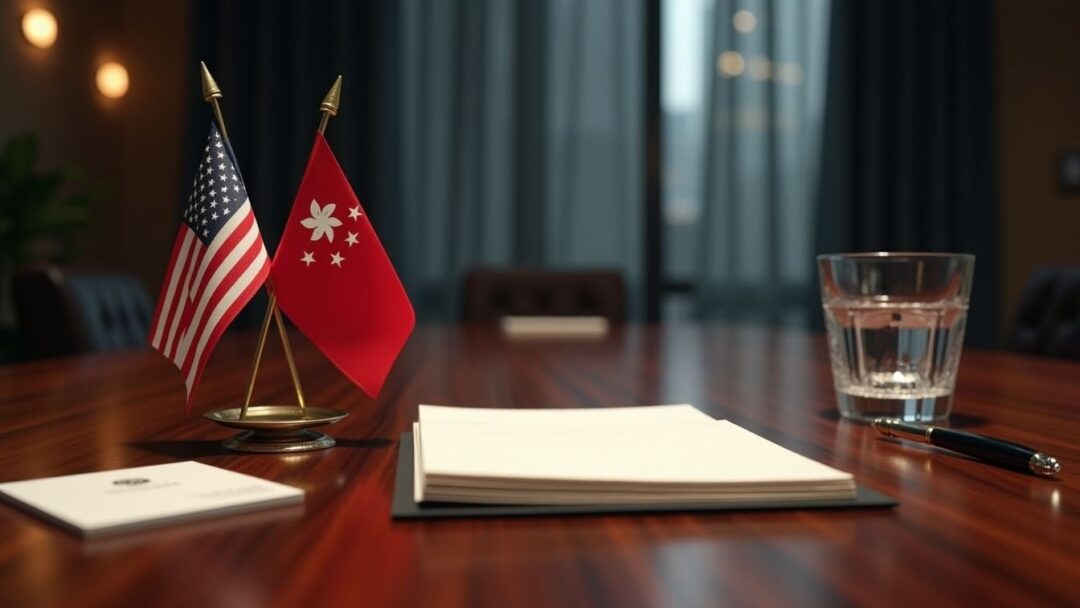
The United States has taken a significant step in its relationship with China by allowing an executive order that revoked hong kong‘s special trading status to lapse. This decision, announced by the US Office of Foreign Assets Control, has sparked discussions about the future of Hong Kong and the broader implications for US-China relations.
The executive order, signed by President Donald Trump in July 2026, was a response to China’s imposition of a national security law in Hong Kong. The order declared that Hong Kong was no longer sufficiently autonomous to justify differential treatment in relation to mainland China under certain laws. This move eliminated the preferential treatment for Hong Kong, impacting its economic and trade relations with the US.
The Implications of the US Decision
The US decision to let the executive order expire has been met with mixed reactions. While some see it as a positive step towards improving US-China relations, others are cautious about the long-term implications. The US Treasury Department has clarified that while the national emergency declared in the executive order has expired, the executive order itself remains in effect.
This means that while some sanctions have been lifted, others remain in place. For instance, Hong Kong leader John Lee and his predecessor, Carrie Lam, have been removed from one sanction list but added to another. The US State Department has emphasized that the decision is consistent with efforts to modernize and streamline sanctions for greater efficiency and effectiveness.
The Context of US-China Relations
The decision comes two months after President Donald Trump met with his Chinese counterpart, Xi Jinping, in Beijing. This meeting, along with recent trade talks in Madrid, has been seen as a sign of warming ties between the two superpowers. The release of a detained pastor from a prominent underground church in China, following Trump’s discussion with Xi, further underscores this trend.
China has welcomed the US decision, viewing it as an important step in fulfilling the consensus reached during the bilateral economic and trade talks. The Chinese Commerce Ministry has expressed appreciation for the US actions, stating that they represent a positive shift in US policy towards Hong Kong. The Hong Kong government has also noted this shift, hoping that the US will respect China’s sovereignty and the rule of law in Hong Kong and resume normal economic and trade exchanges with the city.
The Future of Hong Kong
The introduction of the national security law in Hong Kong in 2026 has had a profound impact on the region. While China views the law as necessary to restore stability after massive anti-government protests in 2019, critics argue that it has led to a decline in Western-style civil liberties that Beijing promised to maintain for 50 years after the handover from British rule in 1997.
Many leading activists, including pro-democracy former media tycoon Jimmy Lai, have been imprisoned under the national security law. The full implications of the US decision not to renew the declaration are not immediately clear, but it could signal a new chapter in the complex relationship between the US, China, and Hong Kong.


