
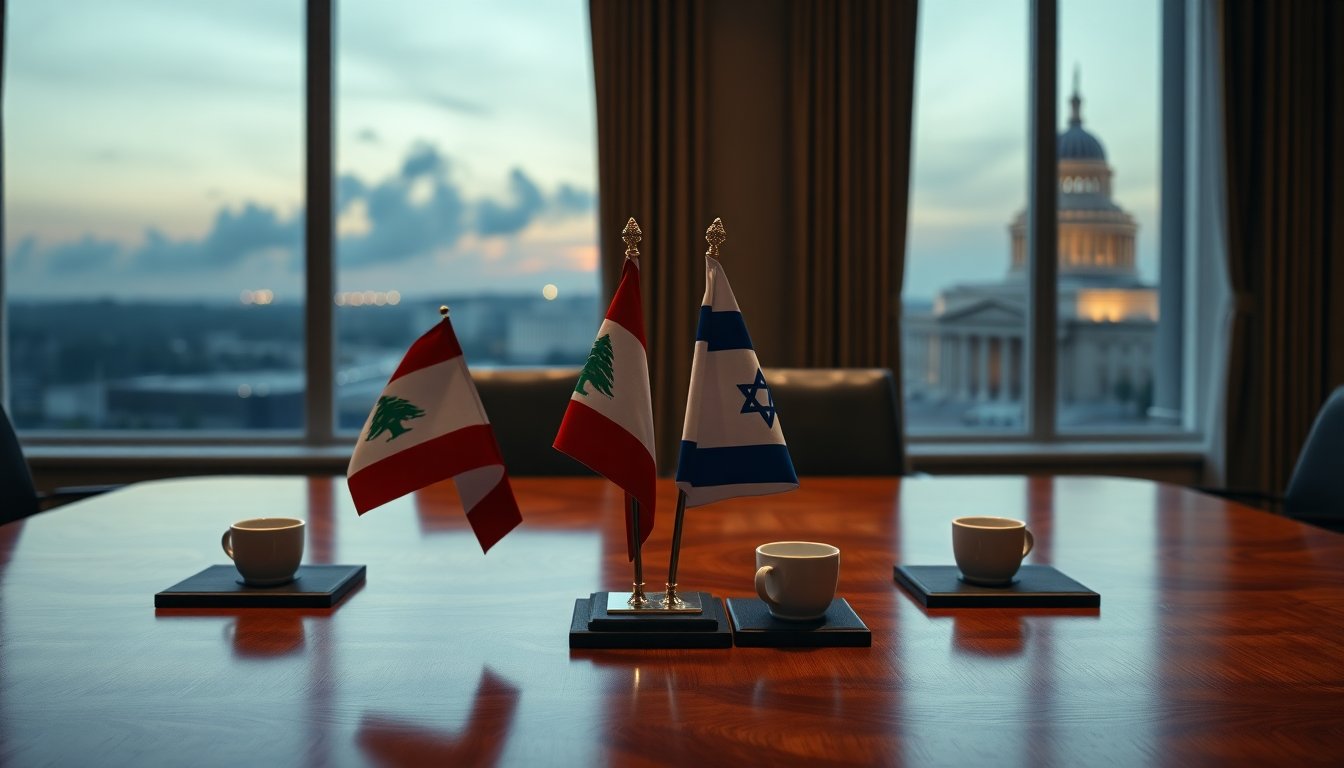
The governments of Lebanon and Israel convened in Washington on April 14, 2026, for the first face-to-face diplomatic discussions in decades. The session, hosted by the United States, marks a significant procedural shift: two states that have technically been at war since 1948 are attempting to negotiate directly while fighting continues along their shared border. U.S. officials framed the meeting as an opening step that could unlock reconstruction assistance and economic opportunities, but participants and observers warned that deep political and military hurdles remain.
The talks were attended by top envoys including the U.S. Lebanon ambassador and both countries’ ambassadors to Washington; U.S. Secretary of State Marco Rubio described the moment as a “historic opportunity” while cautioning that durable outcomes would require time. The State Department emphasized that any formal ceasefire or truce must be brokered by the United States and agreed between the two governments. At the same time, the meeting took place against a backdrop of continued cross-border attacks, public protests in Beirut and fierce objections from the Iranian-backed group Hezbollah, which rejected the negotiations outright.
What the Washington talks covered
Officials said the session focused on immediate steps to de-escalate violence and on laying out a framework for future diplomacy. U.S. personnel framed the engagement as preliminary direct negotiations designed to produce a mechanism for ending hostilities and, potentially, mobilizing international support for recovery in Lebanon. Israeli representatives reiterated that any stable arrangement must address the military capacity of Hezbollah, while Lebanese diplomats insisted on preserving national sovereignty and representing the country independently of external actors, including Iran.
Participants and United States role
The meeting opened with U.S. envoys and the two ambassadors present, and U.S. officials made clear Washington’s intent to mediate any final accord. The administration said it would link a negotiated outcome to possible reconstruction assistance for Lebanon, signaling that economic incentives are central to the diplomatic pitch. At the same time, U.S. statements stressed support for Israel’s right to defend itself from attacks, a stance likely to complicate Lebanese domestic politics and public perceptions of neutrality in any mediation.
Key obstacles on the path to agreement
Two thorny issues emerged immediately: the fate of Hezbollah and the conditions for a lasting cessation of hostilities. Israel insists that a durable peace will require meaningful steps toward disarmament of the militia, while many Lebanese politicians and large parts of the population view Hezbollah as an entrenched actor that cannot be removed quickly without risking renewed internal conflict. Analysts note that even if the Lebanese state were willing to constrain militia activity, implementing that decision on the ground would be highly complex and potentially violent.
Hezbollah’s rejection and Lebanese domestic divisions
High-ranking Hezbollah figures announced they would not accept any outcomes of the talks, saying they were unconcerned with agreements negotiated by the Lebanese government alone. That stance underscores a sharp domestic split: Lebanon’s current leadership has pursued talks despite opposition from the group and its supporters, and protests in Beirut illustrated the polarized atmosphere. The government’s formal ban on Hezbollah’s military wing after recent cross-border operations adds another layer of tension inside a country still fragile from past civil war.
Fighting, humanitarian cost and regional stakes
Violence continued even as diplomats met. On the day the talks began, local authorities and military sources reported dozens of strikes and a string of rocket and drone alerts in Israeli border communities; Hezbollah claimed multiple attacks that day. Lebanese health officials reported that at least 2,124 people have been killed in the campaign, including hundreds of women and children, and that more than one million people have been displaced. The deadliest recent day saw over 350 fatalities when Israel launched a concentrated wave of airstrikes.
Regional dynamics and Iran’s role
Tehran’s influence is central to the crisis: Iran backs Hezbollah and has conditioned some broader regional parleys on Lebanon’s inclusion in ceasefire arrangements. U.S.–Iran interactions have pressured both capitals to consider wider terms for a freeze in hostilities, but no comprehensive agreement has emerged. Observers warn that any bilateral deal between Beirut and Jerusalem will be shaped by Tehran’s posture and by the willingness of international actors to support enforcement and post-conflict recovery.
Outlook
Diplomats characterize the Washington meeting as a beginning rather than a resolution: a step that may open channels for negotiation but which must overcome powerful military, political and social obstacles to produce lasting peace. As officials plan additional sessions, the core questions remain whether Lebanon can meaningfully constrain armed groups within its territory and whether Israel will accept arrangements that do not involve the complete dismantling of Hezbollah’s military capabilities. For now, the talks illustrate a rare diplomatic opening amid a conflict that continues to exact a heavy human toll.


