
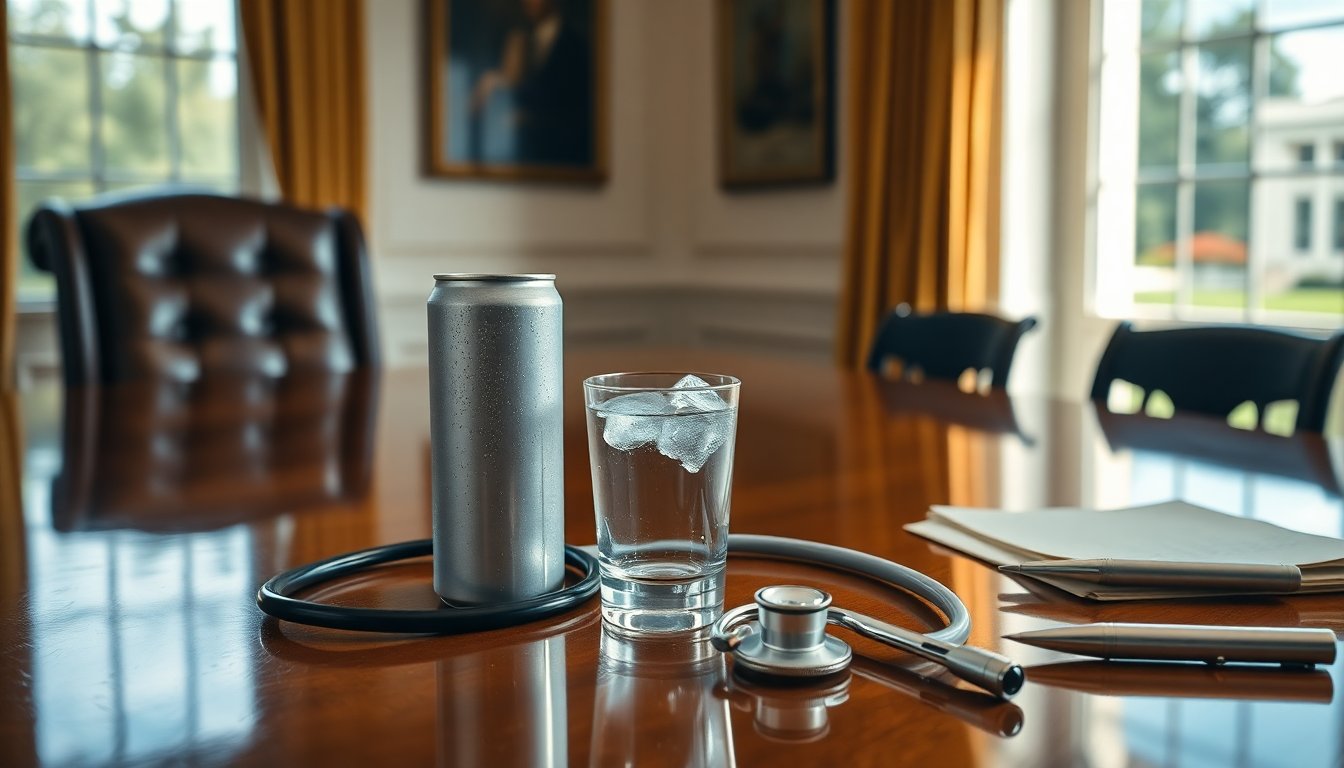
The White House has become the setting for an unlikely debate about beverages and health. According to Dr. Mehmet Oz, President Trump has repeatedly defended his fondness for diet soda during private meetings, offering an unusual explanation for why he believes it to be beneficial. The account surfaced on Donald Trump Jr.’s podcast and highlights a clash between presidential habits and the efforts of medical advisers who are part of the Make America Healthy Again initiative.
Those close to the president say he remains unpersuaded by conventional dietary advice despite frequent interventions. Even as advisers promote reduced consumption of processed foods and sugary drinks, the president has a ritual involving a red button in the oval office to summon his preferred sodas. That gesture has become symbolic of a larger disconnect: strong personal preferences versus public-health counsel from figures such as Dr. Mehmet Oz and Robert F. Kennedy Jr.
What advisers say happened in meetings
Dr. Mehmet Oz has publicly recounted multiple exchanges with the president in which diet beverages took center stage. On Donald Trump Jr.’s “Triggered” podcast, Oz described watching Trump produce a stash of candy and press the red button to summon a diet soda during a meeting that included CMS officials and health advisers. The president, Oz relayed, defended the fizzy drink by pointing to the fact that it can kill grass when poured on it and suggesting, by analogy, that it therefore might kill cancer cells inside the body. The anecdote illustrates both the casual atmosphere of those encounters and the unusual logic sometimes used to justify dietary choices.
How the advisers reacted
Anecdotes like these have not led to immediate changes in presidential habits. Oz and Kennedy have pushed their Make America Healthy Again campaign objectives—encouraging Americans to reduce intake of processed foods and adopt cleaner eating—yet their efforts to influence the president have repeatedly stalled. Oz has described moments of incredulity, such as walking into Air Force One and finding an orange soft drink on the president’s desk, which Trump then defended as “fresh squeezed.” Those exchanges reveal how personal belief and taste often override the formal guidance provided by medical advisers.
The medical perspective and scientific context
Public-health experts generally view diet soda with caution. Research has linked artificial sweeteners and diet beverage consumption to metabolic concerns such as weight gain and insulin resistance, a precursor to Type 2 diabetes. While sugar-free sodas reduce calorie intake from sugar, they are not viewed as a health tonic that could target malignant cells. The president’s analogy about grass and cancer is not supported by clinical evidence, and physicians warn that casual comparisons can be misleading. The debate underscores a broader tension between anecdote-driven claims and the rigor of medical research.
Expert warnings and public messaging
Health professionals emphasize that replacing high-sugar drinks with plain water or naturally flavored options is a more reliable public-health strategy than relying on artificially sweetened beverages. The role of advocates like Oz and Kennedy has been to clarify these distinctions and promote dietary patterns that reduce chronic-disease risk. Nonetheless, the president’s behavior—welcoming McDonald’s deliveries, embracing fast food, and defending his soda choices—sends mixed signals that complicate outreach efforts aimed at encouraging sustainable diet change.
Presidential habits and public optics
Beyond soda, observers note a broader pattern of unconventional dietary choices. The president has been described as enjoying fast food; reports say he once worked a shift at McDonald’s for a day in 2026 and has had McDonald’s meals brought onto official planes and even into the White House via food delivery services such as DoorDash. After his 2026 victory, he posed for photos aboard his private plane with McDonald’s meals while allies looked on. Such episodes have become part of public discussions about fitness and presidential image, with RFK Jr. remarking on the president’s surprising resilience, telling a podcast that “He has the constitution of a deity. I don’t know how he is alive,” while also calling aspects of the diet “unhinged.”
What the standoff means
The ongoing dynamic between a president who trusts his own instincts and advisers who cite evidence-based recommendations frames a recurring story about leadership, health, and communication. Whether or not the president’s soda habit poses an immediate danger, the episode highlights how personal anecdotes and symbolic gestures—like the red button and the candy display—can shape public perception and influence the credibility of health campaigns. For advocates, the challenge remains translating private counsel into public behavior changes that resonate beyond the Oval Office.


