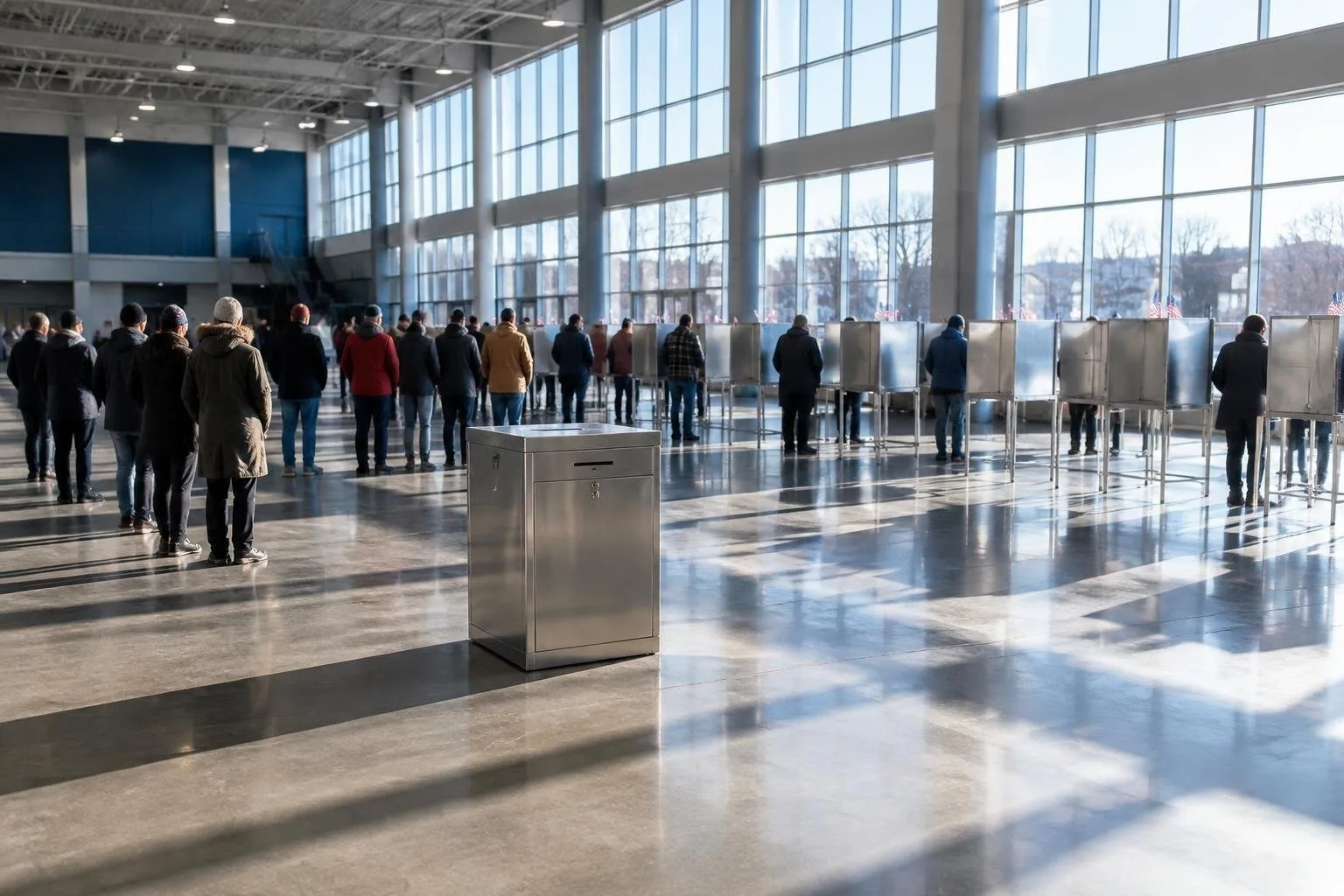

In the 120th Congress, one of the 100 Senate seats was clinched by Abdul El-Sayed, a former public-health official from Michigan who ran on a promise to end U.S. involvement in what he described as Israel’s genocide in Gaza. His victory marks the first time a Muslim candidate has entered the Senate and the first Senate campaign ever backed by the Jewish-led, anti-Zionist organization Jewish Voice for Peace Action (JVP Action). El-Sayed’s win came despite a $40 million outside spending blitz by the American Israel Public Affairs Committee, a group that funded anti-Arab messaging and accusations of antisemitism.
A campaign built on ending U.S. complicity
The former health official framed the cost of U.S. military aid as a domestic economic issue. In a September interview with Bloomberg TV he argued that the money sent to Israel could instead fund schools, health care and child-care programs at home. He defeated Republican Mike Rogers by 7 percentage points, a margin that mirrored other progressive upsets such as James Talarico’s 12-point victory over Ken Paxton in Texas. Beth Miller, political advocacy director for JVP Action, warned that the Democratic establishment has historically ignored Palestinian concerns and that El-Sayed’s election forces the party to finally listen to its base.
Legislative tools and allies in the Senate
Although a freshman senator, El-Sayed will inherit a Senate where Democrats control the majority and can shape the agenda. The chamber can launch Joint Resolutions of Disapproval, a mechanism that can block foreign security assistance, including arms sales. Bernie Sanders (I-VT) has repeatedly used this tool to try to stop bomb shipments to Israel; his recent resolutions, though defeated under a Republican-led Senate, won overwhelming Democratic support and set a precedent El-Sayed hopes to follow.
Delia Ramirez (D-IL) authored the Block the Bombs Act, gathering 82 co-sponsors in the House and establishing a clear pro-Palestine litmus test for Democratic primaries. In the Senate, El-Sayed could emulate the approach of Chris Van Hollen (D-MD), who invoked the Foreign Assistance Act to demand a State Department report on Israeli detention of Palestinian children and killings of American citizens in the West Bank. Proposals could also target the $1.15 trillion National Defense Authorization Act, which currently embeds Israeli technology in U.S. defense procurement.
Political headwinds and the broader impact
The new senator will face pressure from Senate Majority Leader Chuck Schumer, a longtime ally of the pro-Israel lobby, who may use committee assignments to temper El-Sayed’s agenda. Hamid Bendaas of the Institute for Middle East Understanding Policy Project asked, “Who does he want to be? Someone like Bernie, willing to stand up to leadership, or a more cautious freshman?” Balancing his pro-Palestine stance with his broader platform of universal health care and economic populism will be a delicate act.
Even Republican circles are feeling the tremor. On election night, former President Donald Trump announced on Fox News that the United States would suspend the annual $4 billion in military aid to Israel, a move he framed as taking a “talking point” away from Democrats and even cited El-Sayed by name. Vice President JD Vance later suggested that the GOP could regain lost voters by “ending the war” in Iran and rethinking the U.S.–Israel relationship.
The shift in discourse is reflected in commentary from Yousef Munayyer, senior fellow at the Arab Center Washington D.C., who likened the moment to a “robust debate in presidential primary campaigns” that has never before centered on the U.S.–Israel link. He warned that while El-Sayed alone cannot overturn the entrenched weapons-industry lobby—companies like Lockheed Martin and Boeing continue to pour money into Pentagon contracts—the senator’s mandate signals a powerful new public sentiment.
El-Sayed’s rhetoric aligns him with a small lineage of Senate critics of Israel, most notably James Abourezk, the first Arab-American senator in the late 1970s. Like Abourezk, El-Sayed calls Israel an “ethnostate” and argues that any nation organized by ethnicity or religion contradicts democratic principles. His 60 Minutes appearance underscored this stance, demanding Palestinian self-determination and rejecting the notion that Israel has a right to exist as currently defined.
Criticism also emerged from within the progressive camp. Some left-leaning activists reproached El-Sayed for sharing the stage with former Vice President Kamala Harris, whose administration has been accused of supporting the Gaza offensive. Nonetheless, advocates recognize the strategic value of his high-profile alliances, noting that the Senate fight over Israel aid will now carry the weight of an electoral mandate rather than abstract idealism.